
Prepare for the NCVT ITI Fitter Trade Online CBT Exam with free study resources available here. Under the Craftsman Training Scheme (CTS), this platform provides complete Fitter Trade study material, including updated Theory notes, Trade Syllabus, Question Banks, Mock Tests, Pdf Books download and Demo papers. All content is designed as per the latest syllabus to help ITI trainees practice effectively, strengthen concepts, and improve exam performance. Access free, exam-oriented learning materials anytime to boost confidence and succeed in the NCVT ITI Fitter CBT examination.
CTS Fitter
Free Online Learning NIMI Question Bank, ITI Syllabus and Pdf Books Bellow.



Frequently Asked Questions
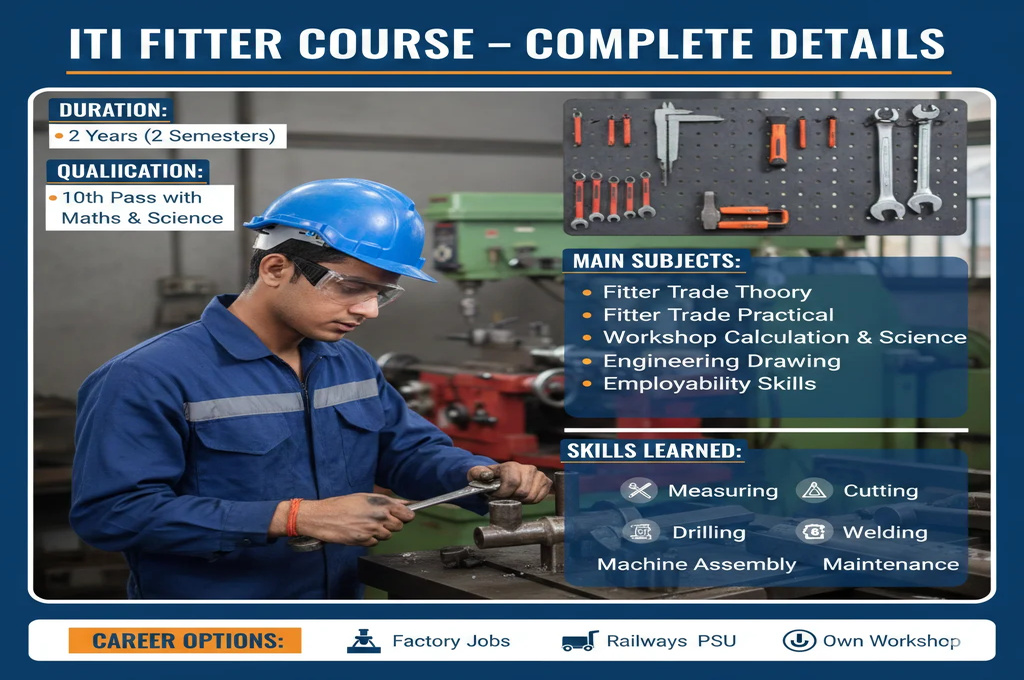
ITI Fitter is a 2 year course , approved by the NCVT (National Council Vocational Training). ITI Fitter Course is a diploma program that focuses on training individuals in the skills required to work as an Fitter.
🎓To take admission in ITI Fitter trade, the basic qualification is:
- ✅ Passed Class 10 (Matriculation)
- ✅ Must have Mathematics and Science as subjects
- ✅ Minimum age: 14 years (some states may have upper age limits)
📌 Other Details
- Admission is usually based on merit (10th marks) or state-level ITI entrance process.
- Both boys and girls can apply.
In simple words, if you have passed 10th class with Maths and Science, you are eligible to apply for ITI Fitter.
In the ITI Fitter trade, students study a total of 5 important subjects. These subjects help build both practical skills and technical knowledge.
🔧 The 5 Main Subjects Are:
- Fitter Trade Theory – Learn the basic concepts of fitting, tools, machine parts, and maintenance.
- Fitter Trade Practical – Hands-on workshop training like cutting, filing, drilling, and assembling.
- Workshop Calculation and Science – Basic maths and science used in mechanical work.
- Engineering Drawing – Learn how to read and understand technical drawings.
- Employability Skills – Communication skills, computer basics, and workplace knowledge.
✨ These subjects together prepare students for jobs in industries or to start their own mechanical work.
Two types of exam are conducted every year for course in ITI in Fitter trade.
- Practical Exam: This is conducted at the training centre/College itself through practical exam and Viva test by an external Examiner.
- Computer Based Test (CBT): In this exam is conducted through computer .There will be one paper 2 hour duration computer based test, conduct by NCVT all subject details are given in the table.
| Subject | Question | Marks |
|---|---|---|
| Fitter Trade Theory | 38 | 76 |
| Workshop Calculation & Science | 6 | 12 |
| Engineering Drawing | 6 | 12 |
| Employability Skills | 25 | 50 |
| Total – | 75 | 150 |
⏳ Course Duration
The ITI Fitter course is a 2-year program divided into 2 semester. Students usually attend classes for 5–6 hours per day, 6 days a week.
Most of the training is practical workshop work, along with some theory and basic employability skills. Below detail Course element and Training Hour discuss-
| Sl No | Course Element | Notional Training Hours |
|---|---|---|
| 1 | Professional Skill (Trade Practical) | 2209 |
| 2 | Professional Knowledge (Trade Theory) | 510 |
| 3 | Workshop Calculation & Science | 170 |
| 4 | Engineering Drawing | 255 |
| 5 | Employability Skills | 110 |
| 6 | Library & Extracurricular activities | 146 |
| 7 | Project work | 240 |
| 8 | Revision & Examination | 520 |
| Total Training Hours- | 4160 |
In the ITI Fitter trade, trainees learn practical mechanical skills needed for industries and workshops.
🔧 Main Skills You Learn
- Marking and Measuring – Using tools like vernier caliper, micrometer, steel rule, and try square.
- Cutting and Filing – Shaping metal pieces accurately with hand tools.
- Drilling and Tapping – Making holes and cutting threads in metal.
- Fitting Work – Assembling and dismantling machine parts properly.
- Lathe Machine Basics – Simple turning and machining operations.
- Welding Basics – Basic gas and arc welding.
- Pipe Fitting – Cutting, bending, and fitting pipes.
- Maintenance & Repair – Repairing machines, pumps, and mechanical equipment.
- Reading Drawings – Understanding engineering drawings and blueprints.
- Safety Practices – Using tools and machines safely in the workshop.
🏭 Extra Skills
- Teamwork and communication
- Basic computer and employability skills
- Problem-solving in mechanical work
In simple words, ITI Fitter teaches you how to make, assemble, repair, and maintain mechanical parts and machines.
After completing ITI Fitter, you can get a job, but that’s not your only option. You can also start your own work. During the course, you learn practical skills like fitting, assembling parts, welding, repairing, and maintaining machines. These skills help you earn money on your own.
Here are some self-employment ideas you can start after becoming a qualified ITI Fitter:
🔧 1. Start Your Own Mechanical Workshop
You can open a small workshop or garage in your area. In your workshop, you can provide services like:
- Making machine parts and doing metal fitting work
- Repairing machines and equipment
- Assembling and dismantling mechanical parts
- Doing lathe and drilling work for local customers
Your customers can be small factories, shops, construction workers, and local people.
🛠 2. Fabrication and Structural Work
Many ITI Fitters start small fabrication businesses. You can make:
- Iron grills, gates, railings, and steel furniture
- Windows and shutters
- Pipe fitting and structural works
These services are always needed in house construction and renovation projects.
🔩 3. Repair and Maintenance Services
You can work independently as a technician. You can repair:
- Water pumps and pipe fittings in homes
- Vehicle parts and workshop tools
- Small machines used in shops or factories
People always need reliable technicians for repair work, so this can give you regular income.
🏭 4. Contract Work with Industries
You can take contract work from:
- Factories that need regular machine maintenance
- Construction sites
- Small manufacturing units
Some contracts may be short-term, while others can provide long-term work.
📈 5. Improve Your Skills and Grow
After starting your work, you can increase your income by learning extra skills like:
- Advanced welding and fabrication
- CNC machine operation
- Advanced machine repair techniques
The more skills you have, the more customers you can attract.
🧠 Simple Tips for Success:
✅ Keep photos of your work as proof of your skills
✅ Promote your services on social media and WhatsApp groups
✅ Build good relationships with local shop owners and contractors
✅ Provide home service — many customers prefer doorstep repair